


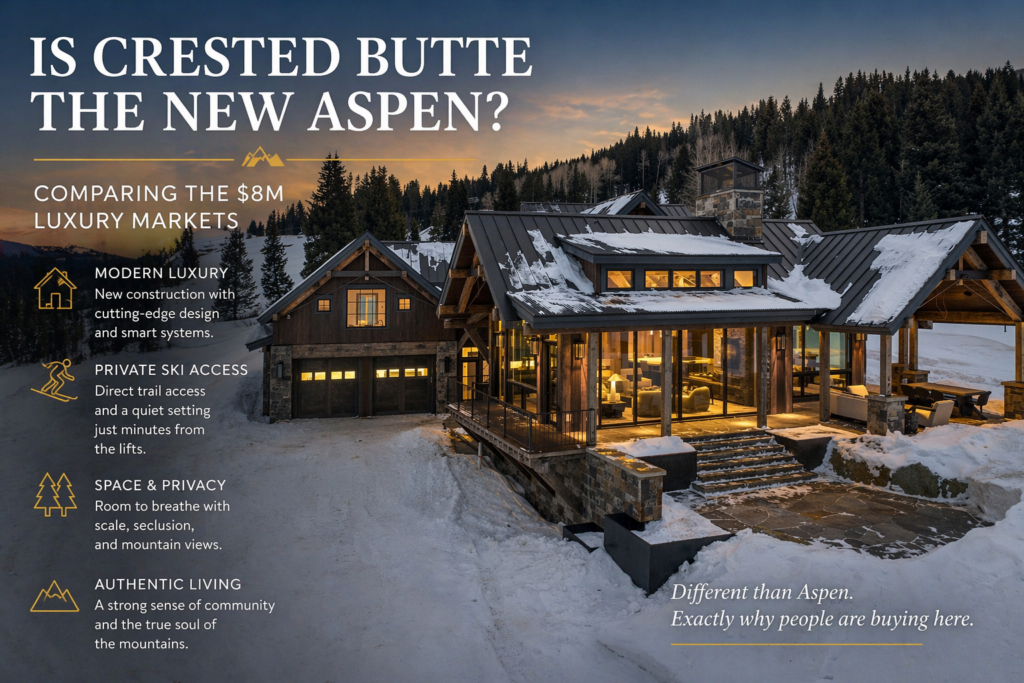
There’s a certain moment in Crested Butte—usually early morning, before the lifts start spinning—when everything feels still. No crowds, no noise, just that quiet sense that you’ve found something a little more real than the typical resort experience.
That’s what keeps coming up lately in conversations. Buyers who would have defaulted to Aspen five years ago are now taking a harder look here.
So the question comes up naturally: is Crested Butte the new Aspen?
On paper, it’s easy to make the comparison. Both are world-class ski towns. Both command eight-figure price points at the top end. And both attract buyers who want access, lifestyle, and long-term value.
But that’s not actually what’s happening.
Architectural Freshness vs. Legacy Pricing
In Aspen, an $8M budget often means stepping into something older—a legacy property that carries the weight of the location more than the structure itself. Renovation is usually part of the equation.
What’s interesting is that Crested Butte is in a very different phase. We’re seeing a wave of new construction that’s redefining the upper end of the market.
Take 18 Walking Deer Lane in Mt. Crested Butte. At that same price point, you’re getting a brand-new, 5,000+ square foot home built for how people actually live today. Clean design. Smart systems. Efficient, modern construction.
In reality, you’re not paying for history—you’re stepping into something current.
The Reality of Ski-In/Ski-Out
Ski-in/ski-out means different things depending on where you are.
In Aspen, it often comes with energy. Busy base areas, constant activity, and a level of visibility that’s part of the appeal for some buyers.
Here, it plays out differently. Access still matters, but the experience feels more private. Properties along Walking Deer Lane offer direct trail connections that don’t feel like you’re in the middle of a resort village.
What we’re seeing is buyers gravitating toward that quieter version of access—where you can still be on the lift in minutes, but your home feels like a retreat, not a stage.
Culture: Visibility vs. Ease
Aspen has always been about presence. The restaurants, the events, the scene—it’s part of the identity.
Crested Butte has gone the other direction, almost intentionally.
On paper, the amenities are here—private chefs, high-end builds, concierge-level services. But the culture hasn’t shifted in the same way.
In reality, people come here because they don’t want to be “on.” They want the quality without the performance. A place where you can blend in, not stand out.
Space and Privacy
This is where the difference becomes pretty clear.
In Aspen, space has become a premium at a much higher level. True privacy—larger homesites, separation, quiet—has moved well beyond the $8M range.
Here, you can still find it.
Homes like 18 Walking Deer Lane offer scale, breathing room, and a level of privacy that’s getting harder to replicate in more mature resort markets. Not just square footage, but actual separation from the pace of everything else.
So…Is Crested Butte the New Aspen?
No. And that’s exactly the point.
What’s interesting is that buyers aren’t looking for a replacement—they’re looking for an alternative.
On paper, Aspen still leads in price and global recognition. But in reality, Crested Butte is attracting a very specific type of buyer. Someone who values design, access, and long-term upside—but doesn’t need the spotlight that comes with it.
What we’re seeing is a market that’s growing up, not catching up.
And for buyers in that $8M range, it creates a different kind of opportunity—one that’s less about status and more about how you actually want to live.
This is the kind of market where understanding the details makes a big difference.
Looking to experience the pinnacle of the Crested Butte market? Explore 18 Walking Deer Lane—a 2025 luxury build featuring 4 bedrooms, 6 bathrooms, and 5,271 square feet of pure mountain elegance.